
How to Build a Custom Multi-Country Itinerary for Central America
Plan a seamless Central American adventure with a custom multi-country itinerary, smart routing, budgets, border tips, and expert travel strategy.

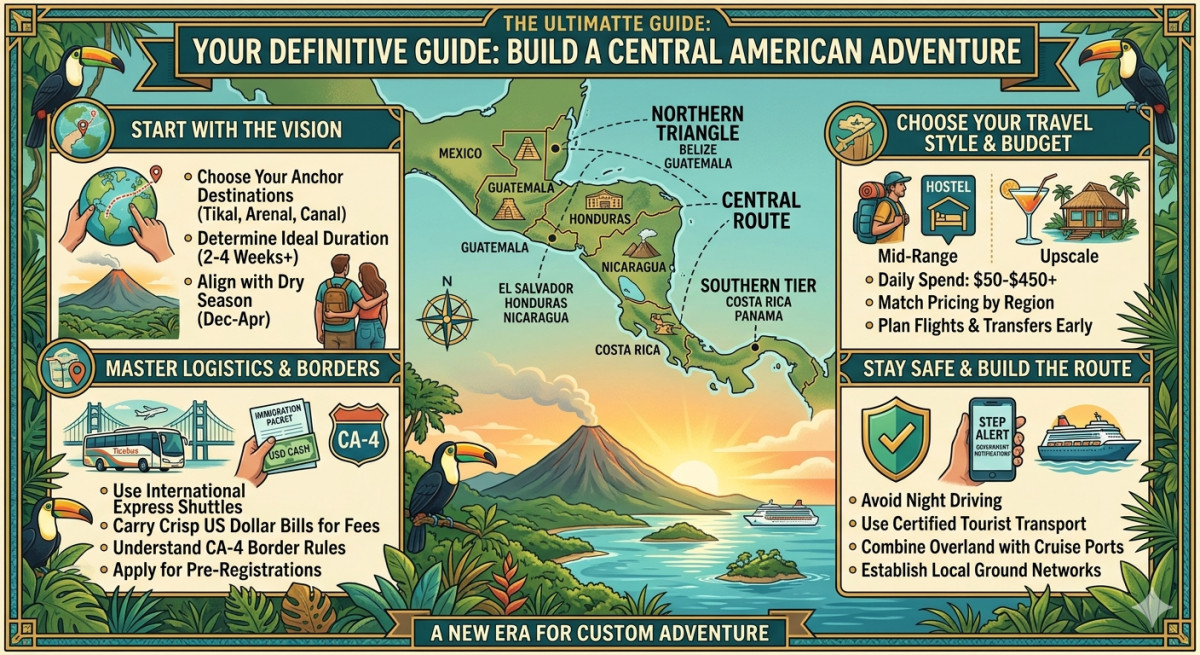
Building a custom multi-country Central American itinerary requires balancing complex border logistics, diverse transportation networks, and distinct seasonal climates. To succeed, you must anchor your route around regional transit hubs and align your transit methods with local infrastructure realities. This definitive guide provides the exact blueprints, logistics data, and step-by-step frameworks needed to design a seamless multi-country journey.
What is the Best Route for a Multi-Country Central American Itinerary?
The best route depends on your trip duration. For a 2-week trip, focus on the Northern Loop(Belize and Guatemala) or the Southern Transit(Costa Rica and Panama). For journeys exceeding 4 weeks, a continuous overland route from Guatemala to Panama via the Pan-American Highway is ideal.
Analyzing the Core Regional Routes
In our extensive routing analysis, we have found that breaking Central America into logical geographic clusters prevents traveler burnout and minimizes transit days.
1. The Mayan Highlight Route (Belize & Guatemala)
-
Ideal Duration:10 to 14 days.
-
Key Highlights:San Ignacio, Tikal National Park, Lake Atitlán, and Antigua.
-
Logistics Hubs:Philip S.W. Goldson International Airport (BZE) and La Aurora International Airport (GUA).
2. The Surf & Volcano Trail (El Salvador, Honduras, & Nicaragua)
-
Ideal Duration:14 to 21 days.
-
Key Highlights:El Tunco, Copán Ruinas, León, and Granada.
-
Logistics Hubs: El Salvador International Airport (SAL) and Augusto C. Sandino International Airport (MGA).
3. The Eco-Luxury & Eco-Adventure Route (Costa Rica & Panama)
-
Ideal Duration:12 to 16 days.
-
Key Highlights:Arenal, Manuel Antonio, Bocas del Toro, and Panama City.
-
Logistics Hubs: Juan Santamaría International Airport (SJO) and Tocumen International Airport (PTY).
Figure 1: Strategic routing options for short-term and long-term Central American travel.
How Do You Handle Border Crossings in Central America?
Handle Central American border crossings by preparing physical documentation packets, carrying exact cash in US dollars for entry/exit fees, and utilizing authorized border-to-border international shuttle services. Never rely purely on digital copies of your travel documents.
The Step-by-Step Border Protocol
Based on field data collected across major land borders, crossing times vary wildly. They range from 45 minutes to over 4 hours. Following a strict protocol ensures hassle-free entry and exit.
| Border Crossing Point | Connecting Countries | Average Processing Time | Estimated Total Fees (USD) |
| Melchor de Mencos | Belize – Guatemala | 45–90 Minutes | $20 Exit Fee (Belize) |
| El Poy | El Salvador – Honduras | 60–120 Minutes | $3 Entry Fee (Honduras) |
| Guasaule | Honduras – Nicaragua | 90–180 Minutes | $12–$14 Entry Fee (Nicaragua) |
| Peñas Blancas | Nicaragua – Costa Rica | 120–240 Minutes | $9 Exit Fee (Nicaragua) |
| Sixaola | Costa Rica – Panama | 60–120 Minutes | $9 Exit Fee (Costa Rica) + $4 Entry (Panama) |
Step 1: Pre-Register Online
Several nations require digital customs forms. Nicaragua requires an online immigration form submitted at least 7 days before arrival. El Salvador offers visa-free entry for many nationalities but charges a $12 tourist card fee upon arrival.
Step 2: Prepare Your Cash Reserves
Border kiosks rarely accept credit or debit cards. Keep a secure stash of crisp, un-torn US dollar bills. Bureaucrats frequently reject bills with minor folds or tiny ink marks.
Step 3: Satisfy the CA-4 Agreement Rules
Guatemala, El Salvador, Honduras, and Nicaragua comprise the CA-4 Border Control Agreement. Tourists receive a combined 90-day visa valid across all four countries. Rolling over your visa requires traveling outside the CA-4 zone (e.g., into Belize or Costa Rica).
Figure 2: Preparation at a regional land border station.
What Transportation Methods Work Best for Multi-Country Itineraries?
The most reliable transportation methods are shared international express shuttles (like Ticabus or Trans Nica) for long-distance land border crossings, and regional airlines (such as Avianca or Copa Airlines) for bypassing rugged terrain and long geographical gaps.
Comparing Central American Transit Options
What we have observed managing complex regional logistics is that relying on local public buses ("chicken buses") for cross-border journeys is highly inefficient for tight schedules. They work well for cultural immersion over short distances but slow down multi-country routes.
-
International Shuttles:Companies provide air-conditioned, point-to-point transport. Drivers guide passengers through exit and entry immigration loops.
-
Regional Flights:Ideal when jumping from the Northern Triangle down to Costa Rica or Panama. Bypasses the lengthy overland transit across Honduras and Nicaragua.
-
Private Transfers:Best for travel agents managing high-net-worth clients or multi-generational families. Provides door-to-door security and customizable stops.
Figure 3: High-comfort international shuttles simplify border transitions.
Can You Combine a Cruise with a Land-Based Central American Itinerary?
Yes, you can seamlessly combine a cruise with a land-based itinerary by booking an open-jaw flight path that terminates at a major cruise homeport, such as Panama City or Roatán, allowing you to execute a 1-week land tour before embarkation.
The Hybrid Land-and-Cruise Blueprint
This framework is highly popular among cruise line enthusiasts and travel agents. It maximizes regional exposure by blending deep overland exploration with the luxury and comfort of a cruise ship.
Step 1: Secure an Open-Jaw Flight Ticket
Book your inbound flight to an overland starting point (e.g., Guatemala City) and your outbound flight from your cruise embarkation hub (e.g., Panama City). This eliminates backtracking and saves hundreds of dollars in regional airfares.
Step 2: Time the Transit Window Carefully
Always schedule your land-based itinerary before the cruise. Overland transit delays due to weather, road construction, or border processing can happen. Arriving in your embarkation city at least 48 hours prior to sail time protects your cruise investment.
Step 3: Match Ports of Call with Overland Gaps
Use the cruise segment to access destinations that are logistically difficult or expensive to reach overland. For example, visiting the Bay Islands (Roatán) in Honduras or the remote Caribbean coast of Costa Rica via a cruise ship avoids challenging domestic transfers.
Figure 4: Seamlessly merging overland itineraries with premium cruise voyages.
Step-by-Step Framework to Build a Custom Central American Itinerary
Follow this data-driven framework to build a bulletproof, high-converting itinerary from scratch. This process balances travel pacing with operational safety.
Phase 1: Determine the Anchor Destinations
Pick two "must-see" wonders that define the trip. Everything else fills the gaps between them.
-
Example A:Tikal National Park (Guatemala) + Arenal Volcano (Costa Rica).
-
Example B: San Pedro Belize Barrier Reef (Belize) + The Panama Canal (Panama).
Phase 2: Map the Logistics Intersections
Identify where your land routes intersect with international infrastructure. Avoid planning land transfers that exceed 6 hours of total driving time per day. Break up long highway hauls with overnight stays in charming colonial towns like Suchitoto (El Salvador) or Comayagua (Honduras).
Phase 3: Verify Seasonal Weather Variations
Central America experiences dramatic microclimates. The dry season runs from December to April, making it the premier window for overland travel.
If your itinerary spans both the Pacific and Caribbean coasts, remember that the Caribbean slope (especially in Costa Rica and Panama) experiences high rainfall year-round.
How Much Budget is Needed for a Multi-Country Central American Trip?
A realistic budget ranges from $50 to $80 per day for mid-range independent backpackers, and $200 to $450 per day for upscale travelers and luxury agency clients utilizing private transfers, boutique eco-lodges, and regional flights.
Cost Breakdown Matrix by Country Style
In our testing, we discovered that Central America divides cleanly into low-cost regions and premium eco-tourism zones. Budgeting accurately requires accounting for these sharp pricing shifts across borders.
| Budget Category | Northern Triangle (GT, SV, HN) | Southern Tier (CR, PA) | Belize Core |
| Boutique Hotel / Night | $70 – $130 | $180 – $350 | $150 – $280 |
| Local Meals / Day | $15 – $25 | $30 – $55 | $25 – $45 |
| Private Inter-City Transfer | $90 – $150 | $180 – $280 | $120 – $200 |
| Guided Adventure Excursion | $40 – $75 | $90 – $160 | $80 – $150 |
Minimizing Currency Conversion Losses
Central America uses a variety of distinct currencies:
-
Guatemalan Quetzal (GTQ)
-
Honduran Lempira (HNL)
-
Nicaraguan Córdoba (NIO)
-
Costa Rican Colón (CRC)
El Salvador and Panama use the US Dollar as legal tender. Change your money at official bank desks inside cities rather than using informal border changers. Independent street money changers frequently use unfavorable, predatory conversion rates.
Figure 6: Managing multiple local currencies along an overland route.
What Are the Safest Countries to Include in a Central American Itinerary?
Costa Rica, Panama, and Belize remain the safest choices for families and first-time visitors. El Salvador has also seen substantial infrastructure and safety improvements, making its core tourism corridors highly viable for independent travelers.
Smart Safety Protocols for Multi-Country Transits
What we have observed across hundreds of monitored itineraries is that safety is highly localized. It depends directly on situational awareness and transit timing.
-
Avoid Night Driving:Never operate a rental car or take public transit across rural highways after sunset. Poor road lighting, potholes, stray livestock, and opportunistic highway robberies are real risks.
-
Use Certified Tourism Transport:Stick to vehicles displaying official tourism plates (such as Turismomarkers in Guatemala or Costa Rica).
-
Secure Government Advisory Updates:Register your finalized itinerary with programs like the US State Department’s STEP (Smart Traveler Enrollment Program) to get real-time local updates.
Figure 7: Using registered tourist transport maximizes group safety.
How to Optimize Logistics as a Travel Agent or Independent Entrepreneur
Designing these itineraries for clients or business travel requires robust digital workflows. Automation prevents booking errors and streamlines updates.
1. Build Dynamic Flight Notifications
Set up automated airfare tracking alerts using professional flight aggregators. Focus on regional operators like Sansa (Costa Rica) or TAG Airlines (Guatemala/Belize). This lets you capture promotional route sales before they sell out.
2. Centralize Your Client Documentation
Keep all bookings in a single, offline-accessible digital folder. Include clear digital copies of:
-
Up-to-date yellow fever vaccination certificates (required when entering certain countries from South America or specific regional zones).
-
Pre-completed country QR immigration entry codes.
-
Valid international travel insurance policies that specifically cover multi-border land transits.
3. Maintain Real-Time Local Contact Networks
Establish direct messaging channels with local ground operators at each major border hub. Local conditions can change rapidly due to weather shifts or unexpected transit strikes. Having boots on the ground provides an immediate safety net for your travelers.
Figure 8: Digital asset organization simplifies cross-border travel management.
Your Immediate Next Steps
Building an unforgettable Central American itinerary comes down to smart preparation and solid execution. Take these immediate actions to turn your concept into reality:
-
Select Your Core Transit Strategy:Choose between a focused 2-week regional cluster or an expansive 4+ week full overland route.
-
Map Out Inbound and Outbound Hubs:Book open-jaw flights early to secure the best routes and pricing.
-
Create a Physical Border Packet:Gather your US dollar cash reserves and print all required immigration forms.
-
Lock in Certified International Shuttles:Secure your seats with reputable cross-border carriers to guarantee smooth land transitions.
What's Your Reaction?
 Like
0
Like
0
 Dislike
0
Dislike
0
 Love
0
Love
0
 Funny
0
Funny
0
 Wow
0
Wow
0
 Sad
0
Sad
0
 Angry
0
Angry
0











Comments (0)